





A spilled straw basket on an Air France flight. An impromptu sketch on an airplane sick bag. A conversation between a British actress and a French fashion executive. This is how the Hermes Birkin was born; a bag that would go on to outperform gold as an investment and sell at auction for over $10 million.
Today, the Birkin sits at the pinnacle of pre-loved designer handbags, commanding prices that increase year after year. For UK buyers considering a Birkin purchase, understanding its rich history isn't just fascinating, it's essential for making an informed investment.
This is the story of how a practical problem became fashion history.
The Origins: How the Birkin Bag Was Born
Long before the Birkin existed, Hermès had already established itself as a master of leather craftsmanship. Founded in 1837 as a saddle and harness workshop in Paris, the house served the equestrian elite throughout the 19th century.
The company's first bag, created in 1892, was called the Haut à Courroies (HAC). Designed for riders to carry their boots and saddle, it featured the sturdy construction and attention to detail that would become Hermès hallmarks. By the 1900s, as automobiles replaced horse-drawn carriages, Hermès pivoted to leather goods, luggage, and accessories.
But it wasn't until the 1980s that Hermès would create its most famous design, and it happened entirely by chance.
The Famous Flight: Jane Birkin Meets Jean-Louis Dumas
The year was 1983. British actress and singer Jane Birkin, known for her roles in French cinema and her relationship with musician Serge Gainsbourg, boarded an Air France flight from Paris to London. She was travelling with her signature wicker basket, stuffed with scripts, nappies, and all the necessities of a working mother.
As she tried to stow her bag in the overhead compartment, the contents tumbled out onto the floor and into the aisle.
By extraordinary coincidence, the gentleman seated beside her was Jean-Louis Dumas, Executive Chairman of Hermès. As Birkin gathered her belongings, she explained her frustration: she couldn't find a leather weekend bag that was both practical and stylish, especially one suitable for travelling with her young daughter, Lou.
Dumas listened intently. When Birkin mentioned needing proper pockets, he suggested she try a Hermès bag. Her response? "The day Hermès makes one with pockets, I'll have that."
Dumas smiled. "But I am Hermès."
1984: The First Birkin Arrives
What happened next would reshape fashion history. During that flight, Birkin sketched her ideal bag on an airplane sick bag; a roomy tote with space for baby bottles, secure closure, and handles strong enough for daily use.
Dumas took inspiration from the Haut à Courroies, Hermès' original equestrian bag from 1900, and created something new. The Birkin officially launched in 1984, featuring double rolled handles, a flap closure with lock and clochette (the bell-shaped key holder), protective feet, and the signature saddle stitching Hermès had perfected in the 1800s.
The first model came in supple black leather. Original retail price? Approximately $2,000. The initial sizes were the Birkin 35 and Birkin 40; larger bags designed for travel and daily practicality.
Jane Birkin received her custom prototype in 1985, complete with brass hardware and a shoulder strap. She later admitted that whilst she loved the design, the bag proved too heavy for regular use, eventually causing shoulder tendinitis.
The Birkin's Journey Through the Decades
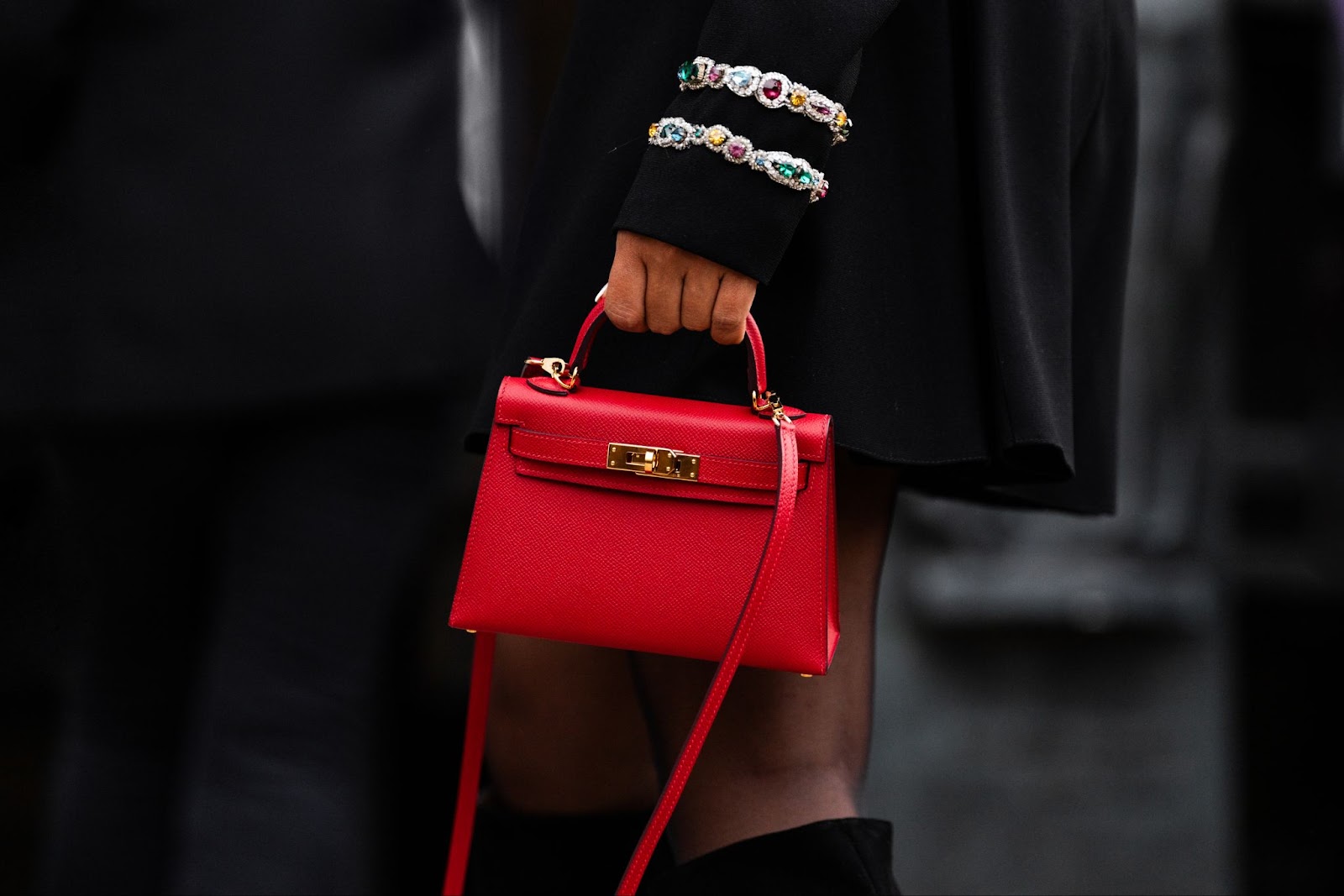
1980s: A Slow Start in Chanel's Shadow
The Birkin didn't become an overnight sensation. Throughout the 1980s, Chanel dominated the designer handbag market, and the Birkin remained relatively under the radar.
The bag's first advertisement didn't appear until 1989; five years after its debut. During this period, Hermès focused on establishing manufacturing standards that remain unchanged today: each bag crafted by a single artisan, requiring 18-20 hours of meticulous handwork.
Early materials consisted of supple calf leathers in muted tones; black, brown, and navy. The emphasis was function over fashion, reflecting Jane Birkin's original brief.
1990s: The Rise of the "It Bag" Era
The mid-to-late 1990s marked a turning point. As fashion entered the so-called "It Bag" era, the Birkin began gaining serious traction among those in the know.
Hermès expanded the size range, introducing the Birkin 30 and Birkin 25; more versatile options for different occasions. The colour palette exploded beyond neutrals, embracing vibrant shades like rouge, bleu jean, and vert céladon.
In 1997, Hermès introduced Togo leather, which would become one of the most popular materials for Birkins. Its scratch-resistant pebbled grain and durability made it ideal for everyday use.
Celebrities began acquiring Birkins, and waiting lists started forming. The bag was no longer just practical, it was becoming a status symbol.
2000s: Pop Culture Phenomenon
The Birkin's big breakthrough came in 2001, when Sex and the City featured the bag in a memorable episode. Samantha Jones name-dropped a celebrity client to skip the "five-year waiting list" for a Birkin. After the episode aired, the actual waiting list reportedly tripled in length.
Victoria Beckham's Birkin collection, rumoured to exceed 100 bags, made headlines worldwide. The Kardashian-Jenner family became known for their extensive collections. The bag appeared on red carpets, in paparazzi photos, and across glossy magazine spreads.
In 2004, Hermès introduced Swift leather and the JPG Shoulder Birkin (sizes 40 and 42), offering more carrying options. The secondary market for pre-loved Birkins also established itself around this time, as demand far outstripped supply.
2010s: Investment Piece Status & Social Media Era
The 2010s cemented the Birkin's reputation as more than a handbag; it became an investment vehicle.
A widely cited study revealed that Birkin bags had achieved average annual returns of 14.2% between 1984 and 2015, outperforming both gold and the S&P 500 Index. Financial publications began recommending Birkins as alternative investments.
In 2010, Hermès announced the end of traditional waiting lists, replacing them with an allocation system that required customers to build "purchase history" with the brand. This became known as "the Hermès game"; a process as mysterious as it is frustrating for aspiring Birkin owners.
Special collaborations emerged, including the Micro Birkin 15 (2011-2012), created by Jean-Paul Gaultier. At just 15cm, it became one of the rarest Birkin sizes ever produced.
The decade also brought controversy. In 2015, PETA exposed inhumane conditions at crocodile farms supplying Hermès. Jane Birkin publicly requested the company "debaptize" the bag until practices improved. Hermès responded swiftly, implementing stricter standards, and Birkin withdrew her objection.
Celebrities began customising their Birkins; Lady Gaga covered hers in graffiti, whilst Kim Kardashian famously carried one hand-painted by her daughter. Social media amplified every Birkin sighting, driving desire to new heights.
Auction records shattered repeatedly. In 2017, a Himalayan Birkin sold for $379,261 at Christie's Hong Kong, becoming the most valuable handbag ever sold at the time.
2020s: Contemporary Icon & Resale Market Boom
The 2020s have seen the Birkin adapt to changing times whilst maintaining its mystique.
Online resale platforms democratised access, allowing UK buyers to acquire authenticated pre-loved Birkins without navigating the allocation system. The pandemic accelerated this shift, with Birkin sales on secondary markets increasing by 38% in 2022.
In 2024, Hermès reintroduced the Shoulder Birkin after an 11-year hiatus, offering it in denim and black leather. The same year, a California lawsuit challenged Hermès' purchasing practices, arguing the allocation system constitutes illegal tying.
The ultimate vindication of the Birkin's value came in July 2025, when Jane Birkin's original prototype sold for $10.1 million at Sotheby's Paris; a world record for any handbag and the most valuable fashion accessory ever sold in Europe.
Current retail prices range from approximately £7,850 to well over £200,000, depending on size, material, and hardware. Pre-loved Birkins often command premiums above retail, particularly for rare colours, discontinued leathers, or store-fresh condition pieces.
The Anatomy of a Birkin: Design Evolution
Core Design Elements That Never Changed
Despite decades of evolution, certain Birkin features remain exactly as Jane Birkin and Jean-Louis Dumas conceived them in 1983:
-
Double rolled handles for comfortable hand carrying
-
Flap closure with touret (leather strap) and sangles (side straps)
-
Lock and clochette, the signature padlock with its bell-shaped leather key holder
-
Four protective feet (clous) on the base
-
Saddle stitching using techniques dating to the 1800s
-
Single artisan signature inside each bag
-
Trapezoid silhouette that tapers from base to top
What Has Evolved Over Time
The Birkin's evolution lies in its expanding possibilities:
Size range grew from two original options to seven distinct sizes: Micro 15 (rare), Birkin 20/Faubourg, 25, 30, 35, 40, and the occasional Birkin 50. The Birkin 25 and 30 are most popular today, whilst the 35 and 40 were the originals.
Leather variety exploded from basic calf to over 30 types. Popular options include Togo (scratch-resistant pebbled grain), Epsom (rigid, water-resistant), Clemence (soft, slouchy), Box Calf (smooth vintage feel), and Swift (supple, lightweight). Exotic skins; crocodile, alligator, ostrich, and lizard, command significantly higher prices.
Colour offerings expanded from early neutrals to thousands of options across Hermès' archived colour library of 75,000+ shades. Each season brings new colours, whilst certain classics remain perennially available.
Hardware options evolved beyond the original brass to include gold-plated, palladium-plated, and special editions featuring diamonds or other precious materials.
Special Orders (marked with an HSS or Horseshoe Stamp) allow VIP clients to customise colour combinations, though options have become more restricted due to demand.
The Kelly vs. the Birkin: Sister Bags, Different Stories
Understanding the Birkin requires understanding its older sibling, the Kelly.
Originally called the Sac à Dépêches and designed in 1928, this structured bag was renamed in 1977 after Grace Kelly, Princess of Monaco, popularised it in the 1950s. When she used it to shield her pregnancy from photographers in 1956, the bag became a sensation.
The key differences? The Kelly features a single top handle and structured, formal silhouette, whilst the Birkin has double handles and a more casual, slouchy shape. The Kelly fastens with a single strap and turn-lock, whilst the Birkin uses two side straps that can be left open or threaded through the lock.
Both bags descend from Hermès' equestrian heritage; the Haut à Courroies that inspired them was designed to carry riding equipment. But where the Kelly evokes Grace Kelly's refined elegance, the Birkin channels Jane Birkin's bohemian practicality.
In today's market, both command similar price points and waiting times, though the Birkin typically enjoys higher name recognition.
Why the Birkin Became a Cultural Icon
The Power of Scarcity
Hermès has mastered the art of desire through restriction. The company refuses to reveal annual production numbers (2014 estimates suggested 70,000 bags). Birkins cannot be purchased online, only through physical boutiques, and only when offered by a sales associate.
Boutiques receive limited allocations twice yearly, with little control over which sizes, colours, or leathers arrive. Aspiring owners must build relationships with sales associates through smaller purchases over time, hoping eventually to be offered a Birkin.
This scarcity isn't artificial; each bag genuinely requires 18-20 hours of skilled handwork by a single artisan. But it creates a mystique that advertising could never achieve.
Celebrity Influence & Pop Culture Moments
Jane Birkin's original cool-girl credibility lent the bag immediate cachet. But it was celebrity obsession that pushed it into the stratosphere.
Victoria Beckham reportedly owns over 100 Birkins, with her collection valued at millions of pounds. The Kardashian-Jenners display theirs regularly on social media. Martha Stewart famously carried hers to court.
The Sex and the City episode remains the most influential pop culture moment, introducing the Birkin to millions who'd never heard of it. Subsequent appearances in Gilmore Girls and countless films cemented its status.
Social media transformed Birkin ownership from private indulgence to public performance, with unboxing videos and collection reveals generating millions of views.
Investment Value & Financial Performance
The Birkin's transformation from handbag to investment vehicle represents perhaps its most significant evolution.
Between 1984 and 2015, Birkins delivered 14.2% average annual returns, significantly outperforming traditional investments. A 2020 Knight Frank report suggested Birkins were better investments than gold or property.
On the secondary market, store-fresh Birkins routinely sell for 50-200% above retail. Rare combinations; Himalayan crocodile, certain discontinued colours, or special editions—achieve even higher premiums.
The Birkin has proven remarkably resilient through economic downturns, with values increasing by 500% since 1984. For UK buyers, authenticated pre-loved Birkins offer entry into this market without navigating the boutique allocation system.
The Birkin in the UK Pre-Loved Market

For British buyers, the pre-loved market offers distinct advantages. You gain access to discontinued colours and leathers no longer available in boutiques. You can choose your exact specifications rather than accepting what's offered. And you can verify authenticity through reputable dealers before committing.
Understanding Birkin history aids authentication. Production era affects details like hardware, stamp locations, and construction methods. Knowing which leathers were introduced and when helps identify potential fakes.
The UK market for authenticated pre-loved designer handbags has matured significantly, with specialist retailers offering expertise in verification, condition assessment, and valuation. These services protect buyers and preserve the investment value that makes Birkins attractive in the first place.
Jane Birkin's Legacy: More Than Just a Bag
Perhaps the most poignant aspect of the Birkin story is Jane Birkin's own relationship with her namesake creation.
She rarely used Birkins regularly, finding them too heavy for practical daily carrying. Of the five bags Hermès gave her over the years, she sold most to raise money for charity. Her annual royalty of approximately £30,000 went entirely to charitable causes, never to personal use.
When PETA exposed animal welfare concerns in 2015, Birkin immediately demanded improvements, willing to sacrifice her name's association until standards changed. This reflected her lifelong activism and ethical commitments.
After her death in July 2023 at age 76, renewed interest in her life revealed the complexity of being forever linked to an object representing wealth and status; values she never personally embraced.
The sale of her personal prototype for $10.1 million in 2025 completed the circle: a bag sketched on an airplane sick bag to solve a practical problem became the most valuable fashion accessory ever sold.
Frequently Asked Questions
When was the Birkin bag created?
The Birkin bag was officially launched in 1984, following a chance meeting between Jane Birkin and Hermès CEO Jean-Louis Dumas on a flight in 1983.
Why is it called a Birkin bag?
The bag is named after British actress and singer Jane Birkin, who inspired its creation after discussing her need for a practical yet stylish bag with Jean-Louis Dumas on an airplane. The design was sketched on an airplane sick bag during their conversation.
How has the Birkin changed since 1984?
Whilst core design elements remain unchanged, the Birkin has evolved through expanded size options (from two to seven sizes), over 30 leather types, thousands of colour choices, and special editions. Its cultural status transformed from practical accessory to investment piece.
What's the difference between a Birkin and a Kelly bag?
The Birkin features double handles and a more casual, slouchy silhouette, whilst the Kelly has a single handle and more structured, formal appearance. Both share equestrian-inspired heritage from Hermès' origins as saddle makers.
Why are vintage Birkins valuable?
Vintage Birkins can be highly valuable due to their rarity, condition, discontinued leathers or colours, and historical significance. Bags from the 1980s-1990s in pristine condition are particularly sought after by collectors.
Are pre-loved Birkins a good investment in the UK?
Pre-loved Birkins from reputable dealers who verify authenticity can be sound investments. Certain sizes (25, 30), leathers (exotic skins), and colours (neutral tones, rare hues) typically maintain or increase value over time. The bag's proven track record of 14.2% average annual returns supports this.
How can I tell what year my Birkin was made?
Birkins contain date stamps (blind stamps) near the Hermès logo inside the bag, indicating production year and the artisan who made it. Understanding these stamps requires knowledge of Hermès' coding system, which changed over the decades.
Did Jane Birkin actually use her Birkin bags?
Jane Birkin had a complex relationship with her namesake bag. She used them initially but found them too heavy, eventually developing shoulder tendinitis. She received five bags from Hermès over the years but sold most for charity, donating her annual £30,000 royalties to good causes.

The information below is required for social login
Sign In
Create New Account